
Game Categories
CE organizes all games on the site into six distinct groups, which we call categories. These include Action, Arcade, Bullet Hell, First Person, Platformer, and Strategy.
Categories exist to help people more easily find games that they might enjoy playing more, as well as keeping relatively similar skillsets contained within a similar set of games.
Action 
Action refers to games in which:
- Combat is the primary focus of the game, AND
- The player's active engagement with enemies through that combat defines the difficulty.
Combat in this context is defined by having multi-faceted ways to interact with enemies' attacks, and dealing damage to them in return.
This may be in the form of different attack styles (light/heavy attacks, weapons, magic, special attacks etc), parrying and/or dodging mechanics, an ability to hide behind cover or engage in stealth attacks, but is not strictly limited to these elements.
Commonly associated genres for the Action category include: Soulslikes, Beat 'em Ups, Traditional Fighting Games, and Action Adventure games.
Site examples include: Dark Souls, Hades, Cuphead.
Additional clarification
It is important to note that the following do not constitute Action attributes, of themselves:
- The existence of enemies in a game that can be killed/damaged. For example:
- Shoot 'em Up games - Destroying enemies is a standard gameplay mechanic of these games. Whilst there are multiple ways to engage with enemies (shooting/bombing, focused attacks etc), these games are explicitly categorised as Bullet Hell.
- Spelunky 2 - This game is characterised by navigating through a hazardous environment, where the enemies act as dynamic obstacles to that navigation. Whilst combat as a primary focus does exist at points (bosses, Sun Challenge), it is not the primary focus of the game as a whole.
- Games where optimal play doesn't have a lot of combat depth.
E.g. Pizza Tower's P ranks requires combo maintenance, and barging through enemies to maintain that combo - the enemies act as a target to reach and break, rather than enemies with whom combat is engaged (i.e. navigating an environment)
- The existence of bosses, or a 'boss rush' mode.
- If engaging with a boss is primarily characterised as platforming
(see: I Wanna Be The Cat - platforming/avoidance-based boss design),
rather than the difficulty being from engaging in combat with the boss(es)
(see: Sekiro™: Shadows Die Twice), then this would not fall under the Action category.
- If engaging with a boss is primarily characterised as platforming
Arcade 
Arcade refers to a collection of loosely related sub-categories which we refer to as "R6" which stands for:
- Rhythm - music based games (eg: MUSYNX / Groove Coaster / Trombone Champ)
- Reflex - reaction based games (eg: Open Hexagon / Hypnocult / RFLEX)
- Racing - traditional racing games (eg: Trackmania / Sonic & All-Stars Racing Transformed / Buck Up And Drive!)
- Recreation - sports games (eg: Infinite Air with Mark McMorris / Golf Gang)
- Record - score attack games / arcade puzzlers (eg: Tetris / LUMINES / Petal Crash)
- Remaining - everything else that can't easily fit into a different category / true variety (eg: Welcome to the Game / Aim Climb / Eggcelerate!)
Arcade was originally used as a kind of dumping ground for anything that couldn't easily be put into the other categories, but more quickly became identified with rhythm and games where reflex and scoring are what defines the difficulty.
Additional points of clarification:
- A game where a player's character is awkward to control, and that is a defining feature of the game, does not immediately meet the R6 criteria for Arcade categorisation above.
- If impacted by gravity, these games with awkward controls will fall to Platformer.
- Arcade in a CE context does not mean anything that was found on an arcade cabinet, or more traditionally associated with arcade games (eg: Shoot 'em Ups).
Bullet Hell 
Bullet Hell includes any game that can be defined as a Shoot 'em Up, as well as any game where the primary element of gameplay is dodging an unmanageably large amount of on screen hazards.
Twin Stick Shooters are also sometimes included in Bullet Hell depending on how much dodging is a theme of gameplay.
Site examples include: The Touhou series, Geometry Wars 3, Star of Providence, Marimoth
First-Person 
First Person refers to any games that are played from the first person perspective and in which you have free directional control over your character.
First Person Shooters are the largest block of games in this category, and First Person Platformers compose the next largest chunk.
First Person also typically includes VR games unless the theme of the VR game is strongly associated with another category such as Beat Saber.
Site examples include: DOOM Eternal, Neon White, Devil Daggers
Platformer 
Platformer refers to any games where difficulty is primarily based on mastering movement through a hazardous environment or from learning how to control your character effectively.
Generally speaking, platformers in CE follow a set of rules for inclusion:
- Platformer games typically challenge the player by asking them to become familiar, comfortable, and or consistent with the physics, movement and environment. Usually requiring precision, memorization, or familiarity with difficult or non-traditional controls.
- Some element of gravity must be affecting the player character, including situations where the player moves by controlling gravity itself (such as VVVVVV or Gravity Den).
- The character must interact with surfaces as a primary element of gameplay.
- Odium to the Core, for example, is a game where surface interaction is either non-existent or minimal. In these cases, a game may otherwise embody all of the characteristics of platformers, but are excluded on this rule.
- Regardless of how non-traditional movement may be (awkward control simulators), as long as the gameplay is derived from navigating a hazardous environment or obstacles, or from learning to control your character effectively, it is still a platformer. This also applies to games where you cannot traditionally jump (Getting Over It and Stilt Fella).
- Gameplay elements from another category cannot strongly outweigh the platforming characteristics.
- For example, Kreedz Climbing is characteristically a platformer, but the First Person perspective overrides its category by default.
- Similarly, there will be many Action Platformers where gameplay is more focused on combat than platforming such as Cuphead and Hollow Knight. Those games would be considered Action.
- You must be in control of your character, and that character must be vulnerable in some way to the environment. Examples where this is relevant are cases where you control a stage (Super Monkey Ball), or you control an object that engages with the primary element of gameplay such as a paddle (Super High Ball). These may be considered Arcade Platformers.
Some commonly associated genres include 2D platformers, 3D platformers, Foddians, awkward control simulators, Metroidvanias (depending on how little gameplay depends on combat), marble games.
Site examples include: Super Meat Boy, Crash Bandicoot, Pogostuck: Rage With Your Friends
Strategy 
Strategy refers to games where difficulty comes from challenging the player's ability to think through and respond to complex situations.
A strategy game on CE must not be guidable in the sense that a "solved" set of actions will guarantee a win. Learning and understanding the core concepts and interactions of the game is a large component.
Strategy games will typically require some form of RNG in order to be considered site worthy.
Any games where RNG is not present means it is likely solveable and or a guide can be used to give all future clears a free path to completion.
However, RNG cannot be so overwhelming that victory comes down to a matter of luck. As a rough rule of thumb, if the game would be unwinnable less than a quarter of the time to a person with infinite working knowledge of the game, then the RNG is potentially too overwhelming to be considered viable for CE.
This category usually includes games where you have as much time as needed to make consequential decisions. Although there are instances where time pressure may exist in a strategy game, the time component itself can't be what makes the game difficult.
Commonly associated genres include Deckbuilders, Grand Strategy, Traditional Roguelikes, Turn-Based, Resource Management.
Site examples include: Slay the Spire, FTL: Faster Than Light, Peggle Deluxe
Multiple categories
As of the update in April 2026, a single game may now have multiple categories applied to it.
Application of multiple categories to a single game should only be made when the difficulty (represented in the point values assigned to the game) arises from characteristics of each category at similar levels.
There is a soft "60/40" threshold for the application of 2 categories - if the defining source of difficulty for the game from a single category exceeds 60% (eg: a 70/30 split), then the game will have just a single category assigned.
Situations requiring Admin approval
More than 2 categories
Should the difficulty for a single game arise from more than 2 categories, and in equal ratios, Admin approval is required to have multiple categories applied.
This is due to the potential multiplier effect, and implications on leaderboards, CR, and other downstream impacts (eg: the Master of All role).
In an extreme hypothetical example, a 120 point game with all 6 categories applied would award 720 total points, or a 6x multiplier to any individual category's worth (20 points of difficulty per category, but 120 points earned in each category).
In this case, with no defining major category, it is most likely to fall into Arcade, under the "Remaining" R6 sub-category.
Due to the implications set out above, it is unlikely a game higher than Tier 1 will be approved to have more than 2 categories.
Applying multiple categories to a high-value games
For the same reasons as set out above, the potential implications of multiple categories being applied to a high-tier game can be material to a number of aspects of CE.
A game being put forward for multiple categories, with a value of 100 or more requires Admin approval.
FAQ
How do you decide where each game is categorised?
The category a game will be allocated to is typically intuitive enough, but there are some games where that is not the case.
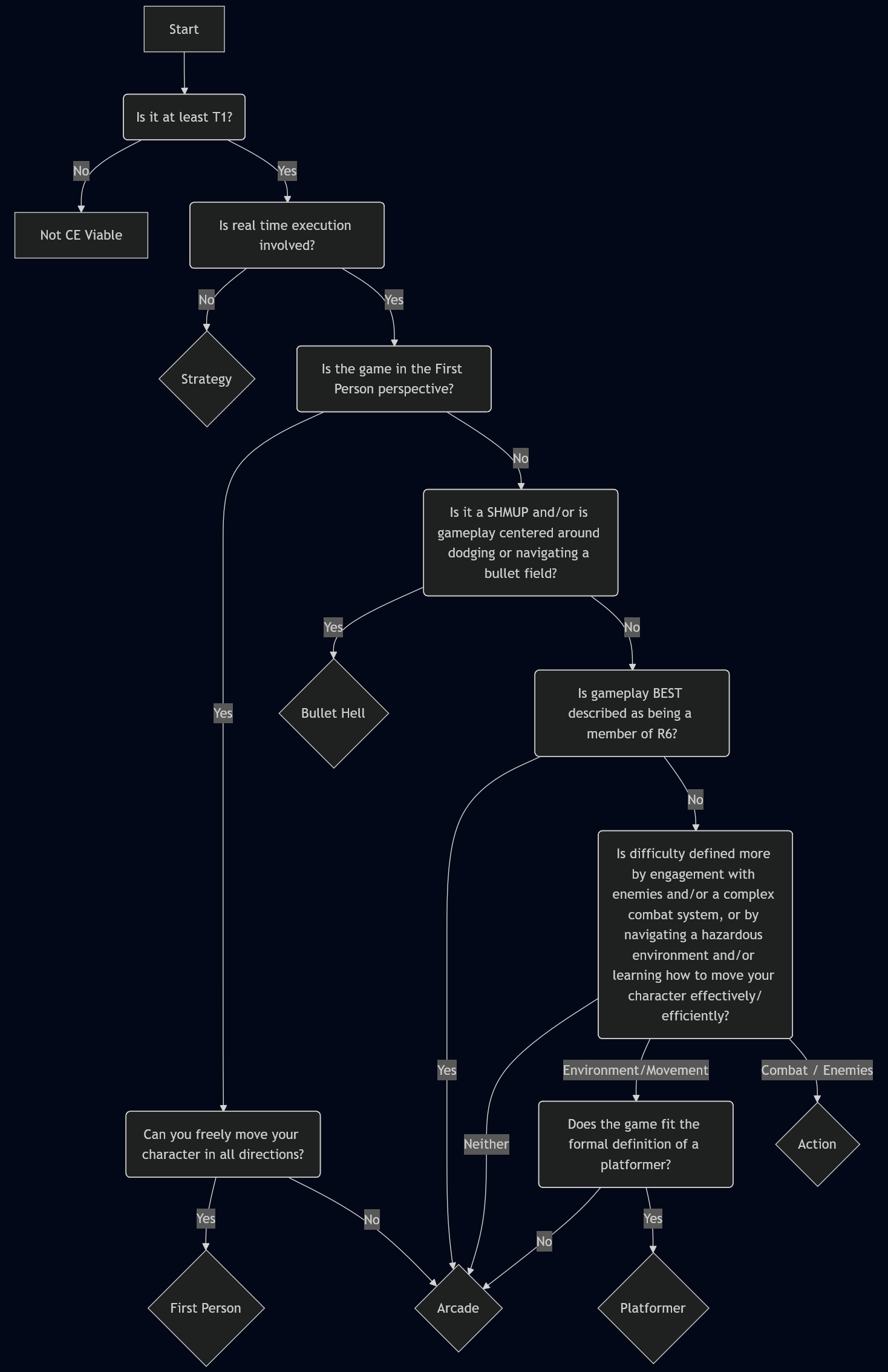
While it doesn't cover all possible bases, when a game's category is not immediately clear, the following flowchart can be used to assist in determining a game's category placement.
Is there any reason for the category ordering?
They are ordered alphabetically. Nothing deeper behind it than that.
Why do we specifically have these 6 categories?
Ultimately, the six categories aim to group games with similar characteristics. There have been proponents to the separation of particular sub-categories (eg: rhythm within Arcade), but equally there is beauty in conciseness.
The genre listings against games aims to assist in identifying core gameplay characteristics that a user may be seeking, with more granularity than that of the category level.