
Valuing Games (an analogy)
Consider the structure for valuing a game like climbing a mountain...
The CE mountain (total game value)
Imagine climbing a mountain is worth 100 points. There are two checkpoints before you reach the summit, so there are legs of the journey in total. The individual value of reaching each checkpoint should always add up to the total value of the game (let's say 20, 30, 50).
Typically when games are valued, it's common for "the entire trip" to be valued at once, and then the total value is divided up amongst the checkpoints.
There are also cases where you hike to the first checkpoint, and consider it to be a trek worth 40 points, and then when you reach the top you are confident the total journey was 100 points, but you gained some perspective along the way that changed your mind about the difficulty of an earlier checkpoint.
You maybe saw a different path you could have taken that would have made it easier, or some other realisation about the perceived difficulty of the hikes to checkpoints at the time.
If every game is its own mountain, each one may have several checkpoints en route to the top; some will have no checkpoints, and only the summit.
- Some mountains are summitted and valued, and then given checkpoints years afterwards.
- Some mountains are given over a dozen checkpoints, because the climb is a long one.
Key principle in game valuations
What should be relied on more confidently is the value of climbing the entirety of the mountain, as the perception of the difficulty of a checkpoint can be unstable, unreliable, or missing the context of climbing the whole peak.
Checkpoints (objectives)
While checkpoints are important, they shouldn't be a reference for climbing another mountain somewhere else, as they are unique to the climb on the mountain in which they sit.
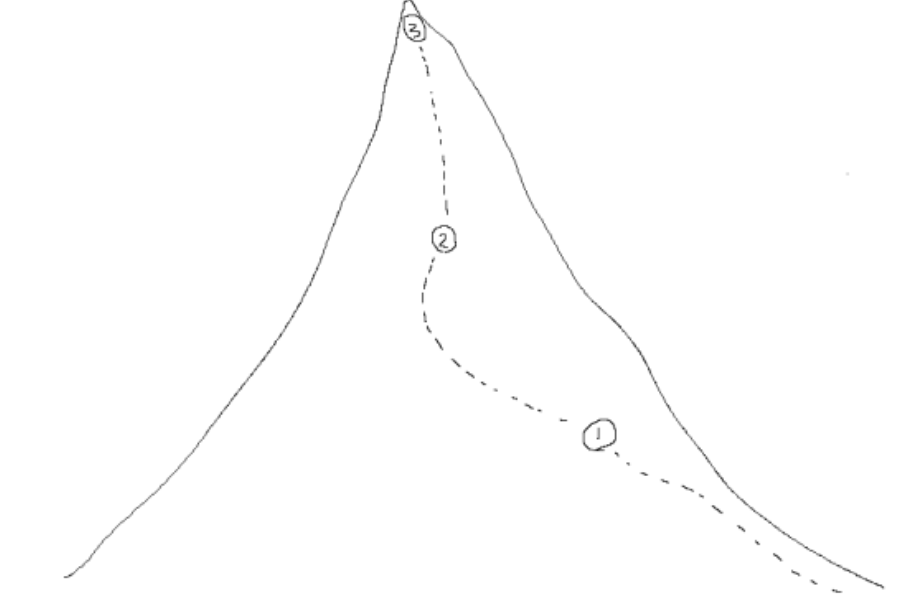
Another example is a mountain that looks like this:
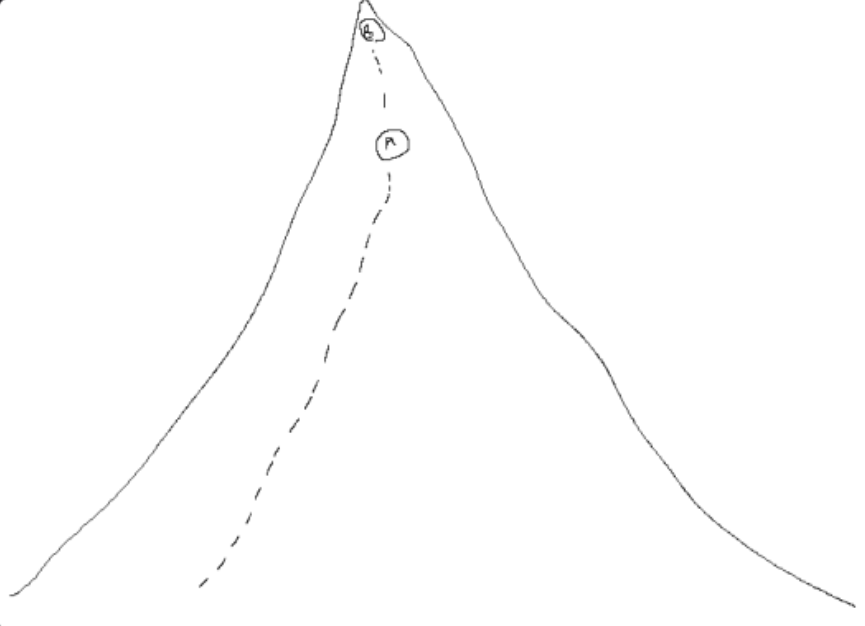
In this case, there is a checkpoint fairly close to the top.
Reaching the first checkpoint would be very difficult, and seemingly most of the trip, but reaching the top of the mountain would be cumulatively 'harder' than reaching the first checkpoint.
However, CE always considers checkpoints to be part of the total value of the climb, so if the total value of the mountain is 100 points, then the checkpoint would be, say, 80 points, and reaching the top would be an additional 20 points.
This can lead to situations that seem confusing, because a challenge that is 'harder' is valued less than a checkpoint before it.
It's because the distance of reaching that checkpoint from the base of the mountain is much longer than the distance of reaching the top from the checkpoint.
Difficulty vs effort (objective values)
In general, a mountain that is more steep is considered more "difficult" or "challenging", and the length of the hike itself can be considered the "effort". The overall value of the hike should be considered a combination of the difficulty and effort of summiting it. That is, the value considers both the length and the steepness of the climb.
Note
For CE purposes, there needs to be an incline ('difficulty') at all for a hike to be given a value.
Consider two hikes:
- One is a vertical/overhanging wall, it is considered high difficulty.
- One is a 50 mile walk on a straight and flat road, it would be considered high effort.
Nothing can have 'no effort', but there are things that can have 'no difficulty' - so we might consider difficulty to be represented as a number between 0 and 10, and effort as a number between 1 and 10.
The vertical wall might be a difficulty of 10, and an effort of 2 - multiplying to get a notional 'CE value' of 20.
The hike might be an effort of 50, but a difficulty of 0 - multiplying to get a notional 'CE value' of 0.
So from a CE perspective, the flat road hike would not receive a (greater than 0) value, and would not end up listed on the site; there needs to be some amount of challenge for a hike to be valued.
A mountain may have an odd shape, such as the following: 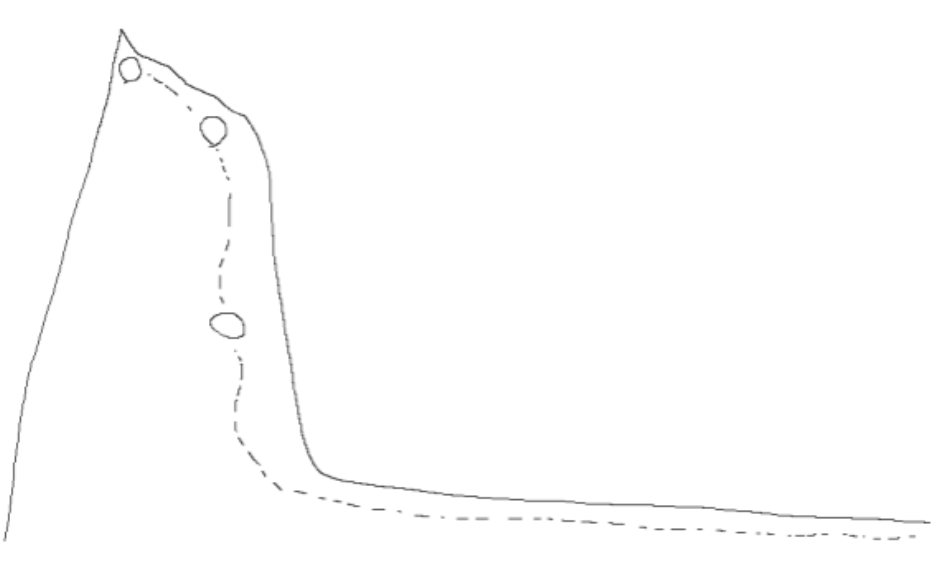
The base of the mountain is at the end of a long and casual walk on a signposted trail. While it make take some time to get to the base of th emountain, the walk to that point isn't challenging, and wouldn't be given a value/checkpoint.
The first checkpoints still only exist once the mountain becomes steep.
Note
When evaluating the difficulty / effort of a climb to the peak, the time it takes to reach the mountain itself shouldn't be considered.
Examples
Hades (time spent doing runs to upgrade the mirror)
N++ (Race mode)
Gurumin (unlocking the final difficulty)
Perceptions of difficulty (game value comparisons)
As mentioned before, the value of the climb is a combination of difficulty and effort.
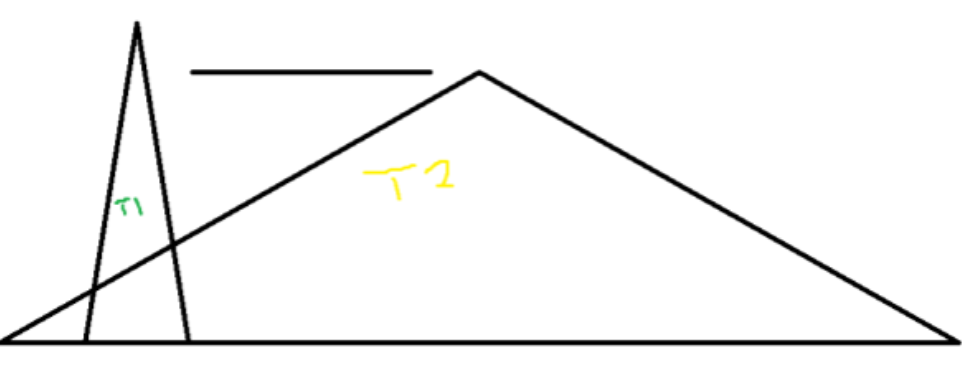
This may lead to a situation where a game that is listed as a T1 can feel harder than a game listed as T2 (as an example, illustrated below).
- The T1 mountain has a difficulty of '3' and an effort of '1' - this could be seen as a single, short and reasonably challenging objective.
- The T2 mountain has a difficulty of '2' and an effort of '2' - this could be in the form of many challenges, requiring more effort, even if the peak difficulty is lower.
The T1 mountain would be a '3' (3x1) and the T2 mountain would be a '4' (2x2).
We highlight that this is only an illustrative example - this is ultimately not directly how value is calculated, but serves as a representation of the 'effort x difficulty' considerations used.
Mountain characteristics (categories)
<< WIP >>
<< WIP >>
Different mountains have different characteristics. We might observe that several mountains are snowy, some might have loose gravel across the entire mountain, and some might have dense stretches of trees that need to be navigated.
Each of these mountains would represent a different CE category. What feels difficult for a tree-lined mountain (say, a Platformer game) won't be directly comparable to a mountain covered in loose gravel (say, a Bullet Hell game).
Comparisons should not be
<< WIP >>
<< WIP >>
Acquiring equipment (skill transfer)
<< SOMETHING ON SKILL TRANSFER >>
Make the analogy something along the lines of getting equipment - pair of ice picks to climb icy sheets. Once you have those picks, your perception of the difficulty will be different.
This might be in VSRGs, Trials, Aim Trainers etc.
<< WIP >>
<< SOMETHING ON SKILL TRANSFER >>
Examples of values in practice
Cloudberry Kingdom
The checkpoints for this game are:
25 pointsBeating the first 318 levels300 pointsBeating 1 additional level (level 319, a ~29 second level)100 pointsBeating 1 further level (level 320, a ~40 second level)
You might visualise this in the mountain analogy as follows (yes, I suck at paint): 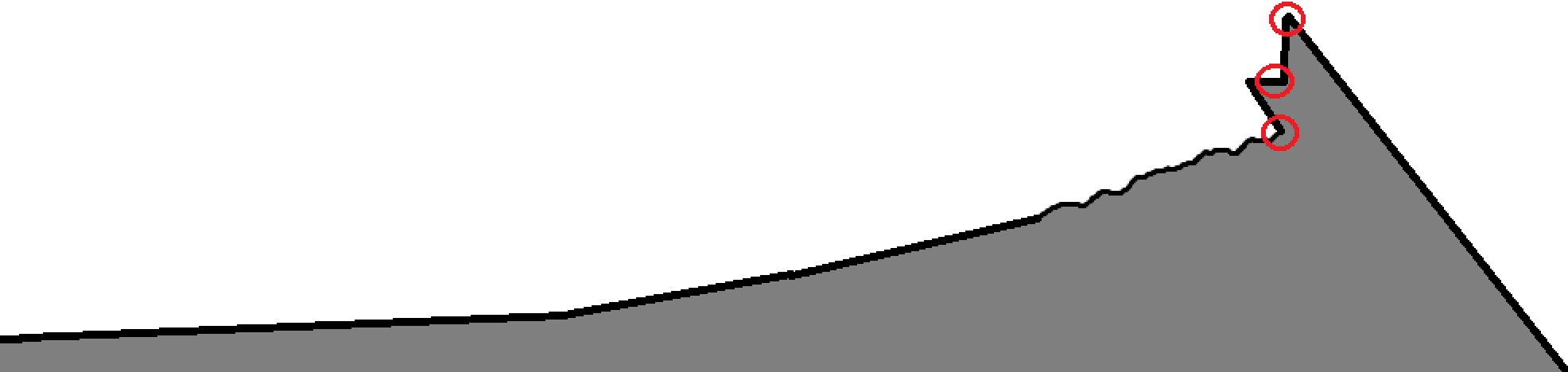
Reaching the first checkpoint involves moving across various stretches, each with a positive incline, and takes a decent amount of effort.
You are then faced with an overhanging cliff. Whilst the fall back down to the last checkpoint is only short, the intensity of the climb is so high that you'll find yourself falling from the cliff over and over again.
You reach the penultimate checkpoint, having cleared Level 319; a safe landing spot to challenge the final vertical climb. Whilst still very challenging, and a bit longer than the previous stretch, it is not as difficult, and you can still recover and attempt the climb again quickly after any fall.
You may choose to visualise these checkpoints using the 'difficulty x effort' analogy as:
- A difficulty of 2.5 and an effort of 3 (a notional 'CE value' of
7.5) - A difficulty of 10 and an effort of 9 (a notional 'CE value' of
90) - A difficulty of 7 and an effort of 7 (a notional 'CE value' of
49)
Whilst the relativity of this hypothetical allocation of difficulty and effort don't align perfectly to the relativity of objective points, they provide an indication of how the objectives' relative values might be determined.
Example 2
<< WITH TEXT >>
Any other good illustrations? Maybe a T2 vs T1?
Or games with a single YOLO vs many sub-components?
<< WITH TEXT >>
Example 3
<< WITH TEXT >>
<< WITH TEXT >>
<< WITH TEXT >>